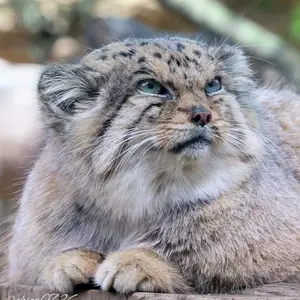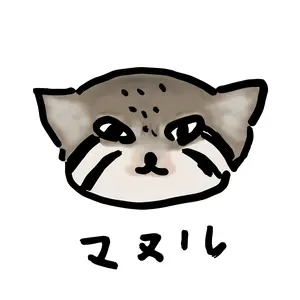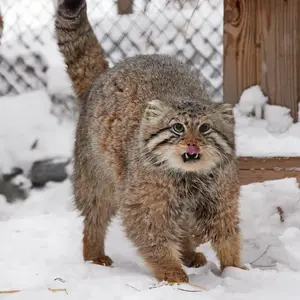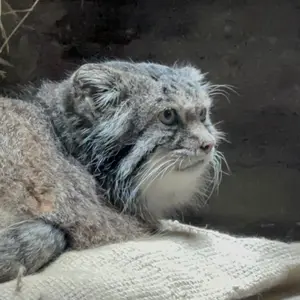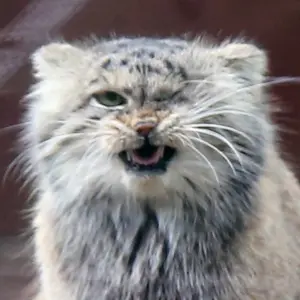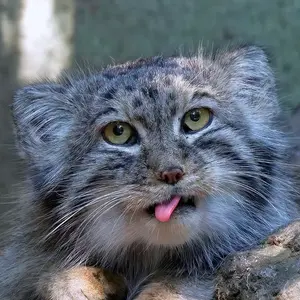
Together with the park’s environmental education team, we held a lesson for children where we told the youngest residents of Kosh-Agach about their wild, fluffy neighbor — the manul.
During the lesson, the kids learned many interesting facts about the manul. Together we watched the cartoon “Children of Maana,” inspired by an Altai folk tale, and also practiced drawing a fluffy rock! 😁
I took an emergency day off work today and visited the gang of Bat-Erdene, Altai and Khutga today at their new home. How exciting! We were playing a bit of a game of hide and seek, but with patience they gave more of a show than expected. Very brave 😻
Living in the North of England, I am so happy to now have two zoos (Edinburgh Zoo and Lakeland) that are both two hours drive from me. Manul day trips! 😻😻😻
Traditionally, the mating season for manuls at the Novosibirsk Zoo begins in February and continues through April.
This year, the handsome George, the eldest son of Zelenogorsk, is once again courting the beautiful Mia — a well-known and beloved fluffy lady of sorrow with an alluring look… oh, what a character she has! 😈
It’s not easy for George to find the key to Mia’s heart this year, and even harder to ask her out. He might even end up stuck in a tree again! 😅🙈
Poznań Zoo reports that Bożenka the Pallas’s cat has been found! Hooray! 🎉
The zoo announces that Bożenka has returned — safe, healthy, and… looking as if she just came back from a weekend in the city rather than an unexpected escape 😼
According to reports, Bożenka was most likely roaming not far from the zoo grounds. She was spotted near Lake Malta and also around the Olszak Pond area.
The fluffy traveler was eventually found on the zoo grounds near the nocturnal animals pavilion, which is located not far from the zoo’s main entrance.
Most importantly — she is in good condition! 🙏
Bożenka will remain under observation until Monday to make sure everything is truly fine.
Sanjiangyuan National Nature Reserve, China has shared a rare footage: a red fox (Vulpes vulpes) with the body of a Pallas’s cat (Otocolobus manul).
The reserve notes that cases of red foxes preying on manuls are not common. Within the Sanjiangyuan ecosystem, such behavior is not merely the “law of the jungle,” but rather a reflection of interspecific competition and an opportunistic predatory strategy under conditions of strong ecological niche overlap.
Both the red fox and the manul primarily feed on small mammals such as pikas. However, in addition to pikas, the fox actively consumes carrion and is capable of taking larger prey, including marmots. Although the ecological niches of the fox and the manul are partially differentiated, during periods of resource scarcity the larger and more omnivorous fox may perceive the manul as a competitor. Elderly, young, or weakened manuls are especially vulnerable and more likely to fall victim to a highly opportunistic fox.
Such mutual restraint among mesopredators reflects the self-regulating mechanisms of the high-altitude ecosystem. At the same time, these dynamics are influenced by external factors such as climate change, habitat loss, and other ecological disturbances. All of this forms part of the complex and fragile mosaic of the Sanjiangyuan ecosystem.
However, the exact circumstances under which the fox in the photograph obtained the manul remain unknown: it is unclear whether the cat was old or ill, or whether the fox found it already dead.
A photo of a Pallas's cat in Sanjiangyuan National Nature Reserve
Today Poznań Zoo reports that during the morning inspection, staff discovered that the facilities where the manul was kept had been opened. According to the zoo, she may have been intentionally released by an unknown individual.
Bożenka’s distinctive feature is the absence of her left eye, which she lost at a young age.
The zoo asks everyone to remain vigilant and carefully look around the area near the zoo and the surrounding neighborhoods.
If you spot the animal, please do not approach her and immediately contact the zoo at +48 663 110 436or the municipal guard at 986.
Today, after a month in quarantine (a standard procedure when an animal transfers from one zoo to another), our fluffy beauty Pepe has moved into her exhibition enclosure! 🔥
Pepe is right in the middle of her move to the exhibition area, inside her transport crate 🤗 Photo: Leningrad Zoo.
Her new home is the enclosure where Shu was born and lived in his childhood (he has now moved to a next door, newly built enclosure).
For the first while, the fluffy newlyweds will be switching places so they can get to know each other from a distance first ☺️
We wish lovely Pepe an easy and gentle adaptation to her new home and the most purr-fect introduction to her precious groom, Shu Svenovich the Pallas's cat!
Great news, everyone! With another batch of photos from camera traps installed with our collaborative support in Kazakhstan, we received some truly unique footage — a Pallas’s cat mom with her kittens passing by one of the cameras!
It may look like pure luck that the camera captured these photos, but in reality, it’s the result of the hard work of the people who carefully selected this particular location and applied their deep knowledge of manuls and their behavior in the wild. That expertise is what made this incredible footage possible.
P.S. The same camera also filmed a family of birds raising their chicks under the huge boulder in the middle of the frame. It’s such a joy to watch them learning to fly — even if you’re not much of a bird person.
ALERT ALERT! All of the steppe unite! Spell Manulization in the comments with your eyes closed. And if we get at least one person who got it right, Zelenogorsk is proud!
ATTENTION! ATTENTION! All of the steppe, unite! Try writing the word "Manualization" in the comments with your eyes closed. If just one person spells it correctly, Zelenogorsk will be proud of you!