
Manul Kittens: How They Grow, Play, and Learn to Hunt
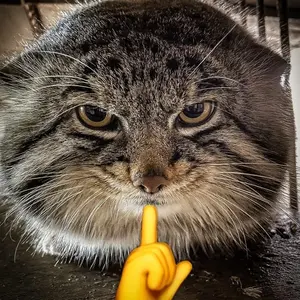
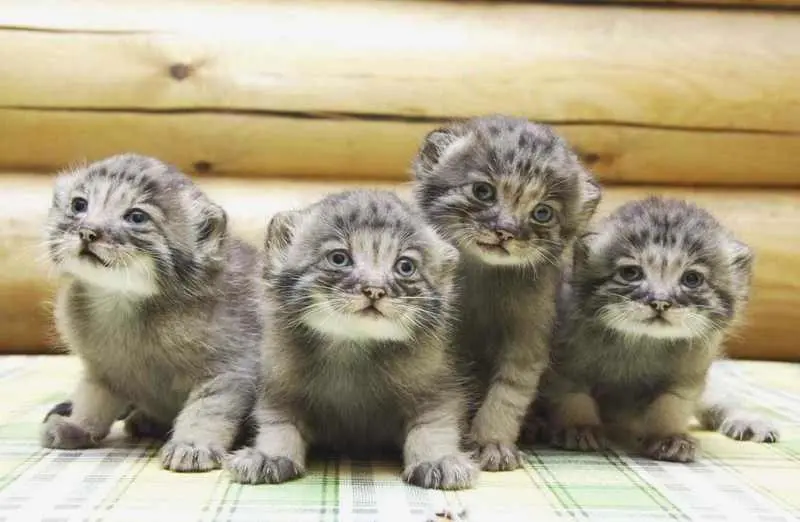
It all begins in May, in a crack in the rock or an old fox den lost among the hills of Tuva or the Mongolian steppes. A female manul gives birth to offspring (from two to six kittens). Each weighs less than 100 grams, and is only a little bigger than a matchbox, though already covered in thick down.
This is not the fluffy coat we are used to seeing in photos of adult manuls. Newborn manuls are gray, smoky, perfectly blending in with stone chips. Nature did not provide them with bright colors, because the mother has to leave to hunt, and the den must remain unnoticed by eagles and wolves.


The first two weeks are a time of absolute darkness and monotonous purring. Manul kittens are blind and orient themselves only by the warm side of their mother and the smell of milk.
By the twentieth day of life, their eyes “depressurize.” The kittens’ world acquires contours, and their bodies take on that legendary spherical shape. Unlike ordinary kittens, who at this age are rather angular, manul cubs grow the densest undercoat. It seems as though they have no neck, and their legs disappear into the abyss of fur.
There is a scientific reason why little manuls are the roundest kittens in the world. Their fur density reaches 9,000 hairs per square centimeter. On the cubs, this fur stands even more upright, since their bodies have not yet stretched out. This creates a comic effect: it is not animals rolling around the den, but tumbleweeds with amber eyes.
It is precisely during this period that their play instinct awakens. But manul play is not a chase after a ribbon.

They play fiercely and intently. Their playground is not a carpet, but stones covered with lichen. There is no grace in their games, only clumsy sideways leaps, funny hissing, and puffed-up cheeks.
The main feature of their games is their low-slung body. They play hide-and-seek and ambushes. If an ordinary kitten jumps onto an object, a manul kitten slips under it, barely lifting its belly off the ground. This is practice for the manul’s main natural weapon — stalking. They learn to be invisible in the terrain.
Zoologists observing litters in the wild and in reintroduction centers note a unique tactic: the kittens practice “freezing.” At an invisible signal from their mother, all three or four gray little balls synchronously turn into cobblestones. Only a very hungry and very attentive predator can tell them apart from the rock at that moment.

A manul mother is a strict teacher. Month-old kittens become incredibly active and begin to try adult food that the mother brings to the den. And that is when the main backstage work begins — learning to hunt pikas.
The pika, or whistle hare, is the basis of their diet. Catching this nimble little creature, which emits a piercing whistle, is harder than it seems. Training is divided into stages:
1. Disemboweling. The mother brings a dead pika to the den. The kittens learn to tear apart the prey, find the most nutritious parts, and deal with the fur.
2. A half-alive training dummy. There comes a moment when the mother brings in her teeth a still-living but stunned or disoriented victim. The little ones go wild. They pounce on the animal, growl at one another, and fight over the carcass. It looks frighteningly cute: round babies, bristling their already upright fur, try to seem like fearsome lions, making deep, booming “hoots.” If the prey tries to escape, the mother does not intervene right away. The kitten must catch up and “strangle” it on its own.
3. A field master class. At two months old, the litter leaves the den. Now they follow their mother on short excursions. She leads them to pika colonies. A pika’s whistle is the school bell. The kitten freezes, the mother demonstrates the classic silent stalk, and then the explosive leap. It is funny that kittens often ruin their mother’s hunt: in their impatience, they cannot hold the pause and give away their presence with a squeak or an awkward movement. At such moments, the mother hisses at them, forcing them to press themselves to the ground.

The main paradox of manul kittens is that they are perfect killers who do not really want to kill. Manuls are among the clumsiest runners in the feline world. Their hearts and lungs are not adapted for long pursuits. So their whole strategy is patience.
The kittens play, but there is no room for a marathon in their games. If a toy (or a brother’s tail) goes to the right, the little one will not run in circles. He will sit and wait for the tail to come back. It is astonishing innate phlegmatism.

By the end of summer, manul kittens are no longer little balls, but cone-shaped adolescents in “glasses” (the characteristic pale outlines around the eyes become more noticeable). By September they reach the size of an adult domestic cat, but weigh significantly more because of their fur. Their first independent winter lies ahead. Their mother will leave them, and each will go off to find its own territory.
Watching a manul litter grow means seeing contrast. Outwardly, they are the most comical creatures on the planet: short-legged, perpetually displeased little faces, ears set wide apart, and the gait of a seasoned infantryman. But inside them lies the sunset glow of the mountains’ steel instincts. Every day of their play is a rehearsal for life in a harsh, sharply continental climate, where the pika is faster than the wind and the shadow of an eagle is deadly.

P.S. I would be grateful if you could help identify manuls in the photos
Comments 7
Ctrl+Enter to send ⌘+Enter to send
This is Aisha and one of her 2018 kittens
This is Lalaa and her kittens — Naim, Yus, and Doloo
This is apparently the Leningrad Zoo, 2006. In the photo are the children of Kora and Leva — little Khan (yes, yes, that very one!), Vtora (Sven’s mother), Prima, and Genghis. https://ru-manulomania.livejournal.com/260435.html?utm_medium=organic&utm_source=yandexsmartcamera
An excellent article!
I especially like the "training" section.
It reminds me of Loesje the mamanul in May, 2024.
She brought a mouse (maybe a part of her meal) to her minuls.
One of the minuls tried eating it!
I miss Loesje🥲
Maeko Ushiro, Maybe you’ll find this interesting: I took a lot of notes and saved them when there was a livestream with Lushe and the kittens https://youtube.com/playlist?list=PLhBQ-9xicnl4ypiyaB20kaGdpVkikxkDP&si=VzWDDZ6RXXnRN-Oz
Анна, Sorry for the late response. Thank you so much!
Анна, Anya, this is priceless video!!! 🫶🫶