
Why is the manul the most elusive predator? An article about ambush hunting tactics and camouflage among the rocks.
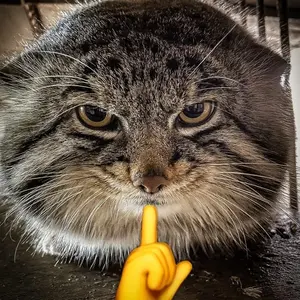

The manul’s appearance is entirely subordinated to one main task: blending into the landscape. Its grayish-ochre coat with barely visible stripes perfectly mimics scattered stones and withered steppe grass, allowing manuls to remain unnoticed.

Its low-set ears let it peek out from behind rocks without rising much above them. Shortened limbs help it press so close to the ground that even low grass, 5–7 centimeters high, becomes reliable cover. And its thickest fur, with up to 9,000 hairs per square centimeter, blurs the body’s outline, making it look like an ordinary stone or a protrusion of rock.

The manul is the slowest member of the cat family. It is not built for long-distance running because of its short legs and dense, stocky build. So its strategy is to wait. It can sit for hours in ambush at the entrance to a rodent burrow or among the rocks, giving itself away by not even the slightest movement.

Sometimes the hunter uses an unusual trick: it twitches its tail to attract the prey’s attention. Hypnotized by the movement, the rodent freezes for a moment, and that hesitation is enough for the predator’s decisive leap.
At night, its camouflage becomes especially effective: the gray fur completely absorbs moonlight without creating any glare. The animal moves in short dashes, crouching low after each step. From a distance, it looks like a slowly creeping shadow, with no sharp outlines and no sound.

That same ability to lie low saves the manul from enemies: wolves, foxes, snow leopards, and large birds of prey. In the open steppe, where there is almost no cover, the only chance of survival is to become invisible. At the slightest threat, the cat drops to the ground and freezes, pressing itself tightly into the soil. It remains motionless for so long that in winter it may be dusted with snow, and that only strengthens its camouflage.

Comments 4
Ctrl+Enter to send ⌘+Enter to send
Oh, fluffy ghost of the steppes, come out and pose for a photo! 😃
And honestly, this is, of course, unbelievably cool — how the manul has perfectly adapted to life in such harsh steppe and mountain conditions. I also really like that it doesn’t make a fuss and doesn’t run after its prey — I like this philosophy, and the manul brilliantly proves by its example that it is very, very effective 👌🏻
Anastasia, thank you for this article!
The last photo is an incredible moment! ⚡
It's somehow inspiring how perfectly adapted to their environment manuls are!
Thank you for the interesting post💘
Prrrrrrrrrr