
About the Moscow Zoo’s educational programs
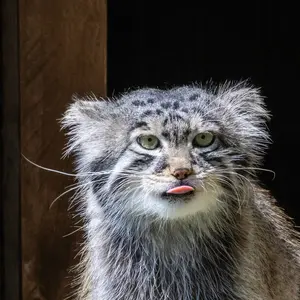
Most of the Moscow Zoo’s educational programs are aimed at children. We even discussed joining the Manulyata club in the Manulization Telegram chat; all we would need to do is forge some documents to bring our age down to about eight. However, there are courses for adults as well. This autumn, I was fortunate enough to take part in one such zoo course, which I will describe in broad strokes in this post.

The course “Behind the Scenes of the Zoo” consists of eight Saturday sessions in October and November. There are lectures on the history of zoo work, animal psychology, and Human Animal Interaction; excursions to various interesting places closed to zoo visitors; training demonstrations with explanations of what, exactly, is going on; and even a tour of the zoo’s holy of holies—the feed kitchen.

I will not dwell on the course program in detail or recount every session. Instead, I will explain why I went there in the first place, what my expectations were, and what came of it. Let me say at once that I am not yet able to draw conclusions: I have not reflected on it all properly enough yet. This is simply a fresh snapshot of my impressions, taken immediately after receiving my diploma.
It all began on the evening of September 7, when I was helplessly rushing around Novosibirsk Zoo in futile attempts to draw anyone’s attention to the condition of my beloved cat Marik. Later, the “diagnosis from a photo” from a private correspondence would be confirmed, and we would say goodbye to Domovyonok. But on that terrible Monday evening and the even more terrible Tuesday morning of September 8, I experienced a mixture of helplessness and bewilderment. Bewilderment over where to run at all and what to do. Whom to turn to, which buttons to press. And there was indignation too, let us not hide it. The main source of that indignation was the realization that we could be useful. After all, it is we who spend hours by the enclosures of our beloved cats. It is we who observe them for hours. Yes, we have neither specialized education nor work experience. But we can be useful. And, what is more, we want to be. A week later (just to put it on record: September 15; by then I was already certain that we would never see Marik again, and was merely hoping for a miracle, while understanding at the edge of my consciousness that there would be no miracle, and that the cat was almost certainly already gone), I saw the course announcement and immediately thought: “There! That is exactly what I need! I will learn how the zoo works from the inside and understand how to fit into the system.”
Reality, as always, turned out to be a little more complicated. And far more interesting.
No, the course did not teach me about either the zoo’s economics or its organizational structure. Overall, I did not receive a single direct answer to the questions I had come to the course with.
Yes, I received much more. I learned what place the zoo occupies in the lives of animals, people, and society. What tasks zoo staff solve every day. How many difficulties invisible to visitors exist literally at every step.
No, nobody took me by the hand and led me to answers to my questions.
Yes, I was given something far greater—they took me behind the scenes of the zoo (see the course title) and showed me what vast expanses lie there, behind the scenes. The rest is up to me.
I do not regret it in the least. In just under two months, I learned a great deal that was new and interesting about animals, people, and their relationships. I began not only to notice but also to understand details that had simply not existed before in the world given to my senses. And, what is more, to habitually acknowledge what I do not understand. And I came to feel deep respect for the hard work of zoo staff.
And the answers to my questions? The key word (see above) is: myself. As a first approximation, I have formulated them. I do not consider it necessary to share more than the most general terms. Life is arranged in such a way that all simple and clear solutions in every field of human knowledge share one remarkable property: they do not work. There is no magic button; no silver bullet has been cast.
We need to learn. And Moscow Zoo offers us wonderful educational programs.
Comments 5
Ctrl+Enter to send ⌘+Enter to send
Let me leaven these general reflections with an example.
— How many difficulties invisible to visitors there are at literally every turn.
I suggest considering an obvious task (to anyone who has ever given it any thought). How do you protect the food-preparation kitchen from rats?
Pavel Burov, just to explain.
If you thought of poison, then you are proposing to kill all the zoo animals in an expensive way (buy food, buy poison, mix them together, poison the animals). Exactly the same result can be achieved for free: you do not buy food, do not buy poison, and simply wait for them all to die of hunger. So I have already saved you money on one solution.
It's very cool that the zoo offers this experience!! 💚
Pavel Burov, Just in case, I’ll also demonstrate here how they reformat people’s minds in the training courses at the Moscow Zoo.
A counter-question:
— What for? Why protect the feed kitchen from rats? Within the context of which area of the zoo’s work is such a task being set?
And with a few simple lines of reasoning, we immediately arrive at this:
1. A person can enter the feed kitchen. Otherwise, it would not be a feed kitchen. Which means a rat can enter it too.
2. We are talking about ensuring animal welfare now, aren’t we? How do rats in the feed kitchen threaten animal welfare?
3. First, they eat the feed. According to a well-known wise joke, anything that can be solved with money is called not a problem, but an expense. This is an expense. It is necessary to provide for a depreciation fund to cover unforeseen needs, conclude direct contracts with suppliers who can quickly deliver the minimum necessary amount of feed in emergency conditions, and so on and so forth. This is an expense, not a problem. What needs to be fought for here is not against rats, but for the budget.
4. Second, disease. This can largely be addressed through preventive measures, for example: ensure sanitary control, arrange with the municipality for regular deratization of the area around the zoo using approved agents, and so on, up to and including (now I’m getting carried away with fantasies) equipping zoo security with air rifles and setting aside a bonus fund for shooting rats.
In short. You should not project your own wishes onto the situation (I want there to be no rats), but solve the tasks of ensuring animal welfare (it is necessary to provide an appropriate standard of care). Note that this is precisely about the silver bullet that has not been cast. Yes, there is no universal solution and never will be; current tasks must be addressed using the means available.
Pavel Burov, Get cats. Well, that's an amateur answer. That's what the ancient Egyptians did, too.
But really, I admire you—your love of nature and your desire to learn new things. Thank you for this little excursion! The next step: perhaps a job as a keeper?