Reposted from the Chinese short-video app Kuaishou. Do not use for any other purposes.

Reposted from the Chinese short-video app Kuaishou. Do not use for any other purposes.
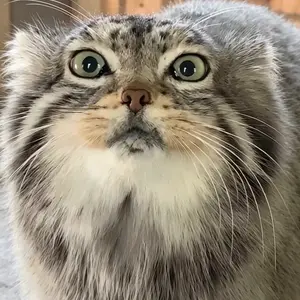
A lot of people think manuls have almost nothing to do with house cats—they're just cute and happen to be in the same subfamily. But come on. Isn't a manul basically just a slightly angrier little cat? They lie around in the sun when they're lazy. They yawn constantly. They groom themselves too—just not in that weird, random, obsessive way house cats do. Okay, I'm done. I'm literally dying of cuteness.
Deep in the frozen heart of Siberia
Live a group of fluffy balls, like little cats
Who are they?
They are Manul
They wear thick and heavy coats
Why do Pallas's cats in Russia look way fatter than the ones everywhere else?
Here's the thing—they look super chunky, but honestly, there's not much meat on them. It's all fluff. Their fur is incredibly long and thick—much coarser and denser than human hair, and so fluffy it makes them look twice their actual size.
The Russian ones belong to the baikalensis subspecies. Since Siberia is freezing cold, they've evolved much longer fur compared to the plateau subspecies (nigripecta) in China and the Central Asian subspecies (manul). Those guys just don't need all that extra fluff, so naturally, they look a lot less… fluffy than their Russian cousins.
Hello everyone, I'd like to share some recent and heartwarming news about manuls from China. It's a great example of how conservation awareness is growing here.
On May 28, 2026, a herder in the Xilingol League of Inner Mongolia discovered a litter of five wild animal cubs in his summer pasture house. He immediately called the local nature reserve for help.
Staff from the Gurgesitai Nature Reserve arrived and identified them as Pallas's cat cubs, a species under China's second-class national protection. The cubs were healthy, active, and showed no signs of injury, which indicated their mother was likely nearby and able to care for them.
It started with two unnamed numbers: N5 and N6.
Born around 1990, they were never given the elegant Russian floral names or the playful Japanese nicknames we see today. They were simply entries in an early studbook, part of a generation where survival was uncertain and every birth was a small miracle.
And yet, from this humble beginning sprang one of the most enduring maternal lines in managed manul history.
N5 & N6 → Lalaa (the resilient matriarch) → Tabby → Shar → Primula → Abrikos (the apricot-hued hope).
Through decades, transfers between zoos, and the ever-present fragility of manul kittens, this line held. When siblings like N18 faded within weeks, when others left no trace, it was Lalaa who carried the torch—becoming the sole known link that connected the 1990s to today.
Who's your favorite Pallas's cat? I love 'em all, but personally I'm most partial to Nanó and Sun Simiao.
In China, people often joke in the comment sections of kitten videos by saying, "XXX could have a whole litter of kittens like this." I think this saying could also apply to Pallas's cats—my friend could have a whole litter of Pallas's cats for me too.
A quick note: Although Pallas's cats look chubby and harmless, they are actually fierce animals that can beat a Tibetan fox in a fight.

Hi everyone,
I’ve attached a photo of a manul (Pallas’s cat) in a video here and I’m hoping someone can help me find the original video source, including the zoo name and the original link.
I also noticed that the paws of this manul look white and seem to have no fur. Could anyone explain why its paws are white and hairless? Is this a normal feature of manuls or something special about this individual?
I only want to collect the source for personal use, no commercial purposes. Thank you so much for your help